
Key events during the reporting period
18 February
“Samruk-Energy” JSC made an early redemption of bonds of the second issue within the first bond program in the amount of 28 bln. KZT in Kazakhstan stock exchange.
03 April
The Head of State signed the RK Law “On making changes and additions to certain legislative acts of the RK on issues related to special economic and industrial zones, attracting investments, development and promotion of export, and social security”, as part of which the RK Law “On power industry” was amended; the amendment allows “Moynak HPP” JSC and “Almaty Power Plants” JSC (boiler No. 8 of CHP-2) to receive individual tariffs for capacity.
10 April
“Samruk-Energy” JSC partially redeemed bonds of the first issue within the first bond program in the amount of 16.8 bln. KZT in Kazakhstan stock exchange.
18 April
“Shardarinsk HPP” JSC raised additional borrowed funds of KZT 11.52 bln. for the Project “Retrofit of Shardarinsk HPP” by signing an additional agreement between “Samruk-Energy JSC, “Shardarinsk HPP” JSC and the EBRD.
23 September
The ceiling tariffs for electricity for 2019–2025 for 44 groups of energy-producing organizations that sell electricity were approved by the order of the RK acting Minister of Energy No. 313; tariffs include interest expenses of implemented investment projects.
7 October
As part of successful implementation of Cash pooling mechanism, “Samruk-Energy” JSC, together with its subsidiaries, repaid the principal of “FWPP” LLP in the amount of KZT 7.6 bln., “APP” JSC in the amount of KZT 3.7 bln. and “AZhC” JSC in the amount of 5.3 bln. tenge. This work contributed to decreasing the debt level of “Samruk-Energy” JSC group by KZT 16,6 bln. tenge.
7 October
“FWPP” LLP (“Samruk-Energy” JSC subsidiary) loan from EDB in the amount of 7,6 bln. tenge was fully repaid ahead of schedule. The deal allowed releasing “Samruk-Energy” JSC guarantee for the same amount in favor of lender.
16 October
“Moynak HPP” JSC signed an Investment Agreement with the RK Ministry of Energy (for a volume of capacity – 298 MW, while an average tariff was 2,467.1 thous. KZT/ MW*month). The individual tariff was approved for the period from 2020 to 2026.
18 October
Amendments the “Rules for the approval of ceiling tariff for electricity, ceiling tariff for balancing electricity and celing tariff for the service for maintaining the availability of electric capacity “were made by the order of the RK Minister of Energy No. 341. According to the amendments, if there is a need for adjustment of the ceiling tariff for electricity during the year, energy producing organizations should submit the information about escalation of costs for electricity production and attach supporting documents to the authorized body no more than once a year.
23 October
“AlES” JSC concluded an Investment Agreement with the RK Ministry of Energy (for a volume of capacity – 69,5 MW, while an average tariff was 3,418.9 thous. KZT/MW*month). The individual tariff was approved for the period from 2020 to 2024.
31 October
A Laon Agreement worth 23,2 bn.KZT was signed between “Ereymentau Wind Power” LLP (“Samruk-Energy” JSC subsidiary) and EDB in order to finance “Construction of 50 MW WPP in Ereymentau c.” project.
28 November
“Moynak Hydropower plant” JSC has converted 11.7 mln. USD of foreign currency liabilities to the Development Bank of Kazakhstan. The transaction allowed continuing the reduction of foreign currency debt rate from 3 % to 1.5 % in the loan portfolio of “Samruk-Energy” JSC.
December
According to the results of 2019, “Samruk-Energy” JSC achieved the target values of financial stability ratios and, accordingly, the “green” risk zone was accomplished.
Macroeconomic factors
In general, the economy of the Republic of Kazakhstan continues to demonstrate some of features that are commonly found in emerging markets. It is particularly sensitive to fluctuations in the prices of oil and gas and other mineral raw materials, which make up the bulk of the country’s exports. These features also include, but are not limited to the existence of a national currency that does not have free conversion outside the country, and a low level of liquidity in the securities market.
The continuing political tensions in the region, the exchange rate volatility have had and may continue to have a negative impact on the economy of the Republic of Kazakhstan, including a decrease in liquidity and difficulties in raising international financing.
On August 20, 2015, the National Bank and the Government of the Republic of Kazakhstan made the decision on stopping supporting the Kazakh tenge exchange rate and implementing a new monetary policy based on the inflation-targeting regime, canceling the currency corridor and moving to a free-floating exchange rate.
At this, the National Bank’s exchange rate policy allows interventions in order to prevent sharp fluctuations in tenge’s exchange rate to ensure financial stability.
As of the date of this report, the official exchange rate of the National Bank of the Republic of Kazakhstan was 377,19 tenge per 1 US dollar compared to 381,18 tenge per 1 US dollar as of December 31, 2019 (31 December 2018: 384,20 tenge per 1 dollar USA). Thus, uncertainty regarding the tenge exchange rate and future actions of the National Bank and the Government remains, as well as the impact of these factors on the economy of the Republic of Kazakhstan. In September 2019, the international rating agency Standard & Poor’s affirmed Kazakhstan’s long-term credit ratings for liabilities in foreign and national currencies at the level of “BBB-” and Kazakhstan’s short-term ratings for obligations in foreign and national currencies at the level of “A-3”, and National scale rating – “kzAAA”.
The outlook on the longterm ratings is stable. A stable forecast is confirmed by the presence of positive balance sheet indicators generated by additional revenues to the National Fund of the Republic of Kazakhstan, as well as low public debt, the total amount of which will not exceed the state’s external liquid assets in two years.
Large-scale budget injections along with a considerable growth of investments, brought through the economy to a new level of growth of 4.5 % in 2019, which turned out to be higher than the average dynamics of 4.2 % over the past decade. A set of targeted incentive and administrative measures supported domestic demand, having mitigated the negative impact of adverse global conditions in oil market, while inflation remained at a moderate level of 5.4 %, which is significantly lower than the long-term trend (source Halyk Finance).


| 31.12.2018 | 31.12.2019 | % | |
| KZT/USD | 384,2 | 381,18 | 99 % |
| KZT/EUE | 439,37 | 426,85 | 97 % |
| KZT/RUB | 5,52 | 6,17 | 112 % |
Growth of output and the stability of oil prices, low unemployment and wage rise contributed to moderate economic growth in 2019. Such an economic environment has a significant impact on the operations and financial standing of the Company.
Management makes every effort to ensure stability for the Company’s business. However, the future consequences of current economic situation are difficult to predict, and current expectations and estimates may differ from actual results.
Moreover, the energy sector in the Republic of Kazakhstan remains exposed to political, legislative, tax and regulatory changes in the Republic of Kazakhstan. The prospects of the economic stability of the Republic of Kazakhstan are substantially dependent on the effectiveness of economic measures undertaken by the Government, as well as on the development of legal, control and political systems, i.e. circumstances that are outside of “Samruk-Energy” JSC group of companies’ control.
Company’s management assessed the potential impairment of “Samruk-Energy” JSC group of companies’ long-term assets taking into account the current economic situation and its prospects. The future economic and regulatory environment may differ from management’s current expectations.

The Management is unable to foresee either the degree or the duration of changes in Kazakhstani economy or assess their possible impact on the financial standing of the Company in the future. The Management is confident that it is making every effort to maintain the stability and growth of the Company’s operations in the current circumstances.
The “Samruk-Energy” JSC group of companies is of strategic importance for the Republic of Kazakhstan, as it unites the enterprises of power sector, which provide the population and industrial enterprises with power.
The Government of the Republic of Kazakhstan has adopted a longterm program for the development of the energy sector of the economy, which involves the construction of new and reconstruction of existing power plants.
It is expected that the Group will receive support from the Government of the Republic of Kazakhstan, as the electricity sector is a strategically important part of the country’s economy.
To estimate expected credit losses, the Company uses confirmed forecast information, including forecasts of macroeconomic indicators.
However, as in any economic forecasts, assumptions and the likelihood of their implementation are inevitably associated with a high level of uncertainty, and, therefore, actual results may differ significantly from those predicted.
Financial and economic indicators
– in FS forex gains for 2018 were reported in «other income» section»
– in FS balance from the exchange rate difference of 2017 was reported in «financial expenses» section
– in FS forex loss for 2018 was reported in “finance costs” section
– in FS forex gain for 2019 was reported in “finance income” section
– in FS impairment loss (NET) was recognized in “other expenses” item
*Note: interpretation of income and cogs was presented with a breakdown by types of activities (not by segments) and was mentioned without elimination.
Revenues from sales of products and services provided across “Samruk-Energy” JSC Group of Companies in 2019 amounted to 243,722 mln. tenge:
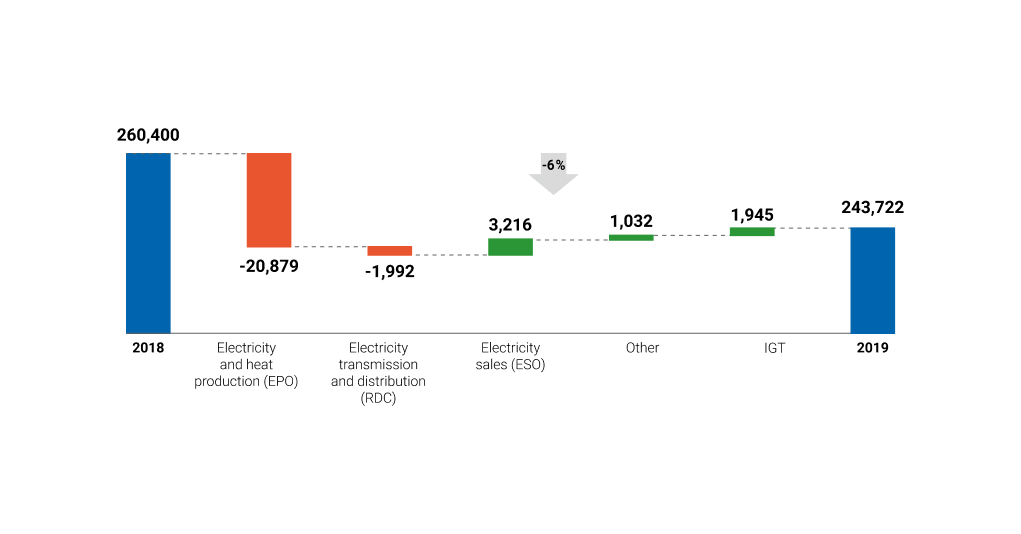
Consolidated revenue decreased in the electricity generation segment due to lower tariffs and volumes of electricity sales.
The main decrease occurred at “Ekibastuz GRES- 1” LLP because of a decrease in electricity sales volume from 18,340 mln. kWh to 17,642 mln. kWh and a decrease in the average tariff from 6,86 tenge / kWh to 6,07 tenge / kWh.
The decrease in revenue for electricity transmission is connected with a decrease in “Alatau Zharyk Company” JSC tariff for electricity transmission from 5,89 tenge/kWh to 5,46 tenge/kWh.
As regards the sales segment, revenue growth is because of an increase in electricity sales by “AlmatyEnergoSbyt” LLP.
Structure of 2019 income by main types of activity
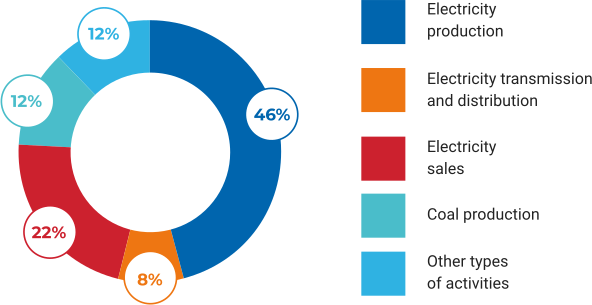
Forecast for the future period: in the forecast for 2020, revenue from sales is planned in the amount of 289,052 mln. tenge, which is 45,330 mln. tenge or 19 % higher than the 2019 actual.
The increase is due to growth of rates for electricity generation and transmission. Revenue in the forecast for 2021increases vs. forecast for 2020 because the income from electricity production grows, mainly owing to an increase in electricity generation, electricity rates and rates for provision of services for maintaining the availability of electric capacity.
In addition, revenues from the transmission and sale of electricity are expected to grow because of an increase in volumes and tariffs.
Revenues from sales of products and services rendered detailed per producer
The major share in the Company’s operating income comes from “Ekibastuz SDPP -1” LLP, “Almaty Power Plants” JSC, “Alatau Zharyk Company” JSC, “AlmatyEnerogSbyt” LLP. At the same time, at consolidation of revenues, intercompany turnover mainly in respect of energy producing and distribution companies is excluded from total amount.
Cost of goods and services
1 in FS emission charges for 2017 were recorded in “Others” item.
2 in FS emission charges for 2018 and 2019 were recorded “Taxes other than income tax” item.
According to the 2019 results,the cost of goods sold, amounted to 195,891 mln. tenge, which is 4 % higher than the 2018 actual. An increase in expenses is mainly related to the costs of maintaining the availability of electric capacity in connection with the introduction of the capacity market and the division of the tariff into electricity and capacity components.
Payment for capacity is made to the SFC. Previously, these expenses were completely intergroup and were eliminated. There is also an increase in expenses due to rising prices for goods and services, and an increase in depreciation (mainly at “Ekibastuz SDPP-1” LLP).
The structure of cost of goods sold by main types of activity
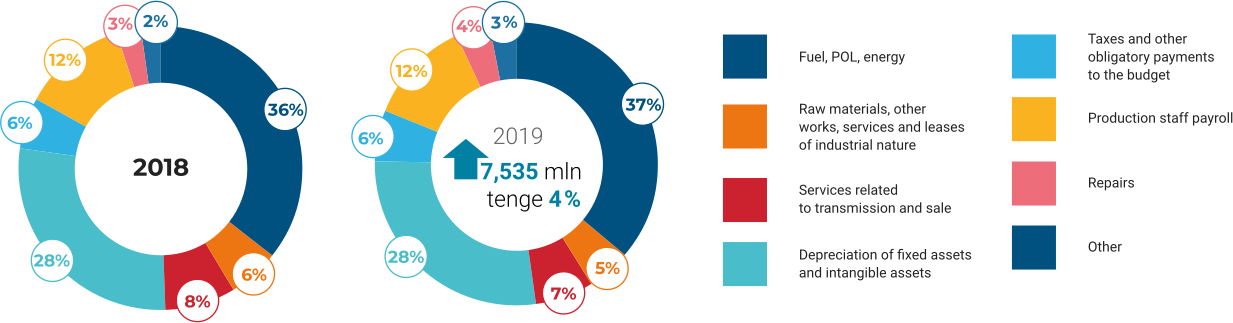
Forecast for the future period: in the forecast for 2020, cost of goods sold increases due to the growth of production and sales, as well as due to an increase in prices for goods and services. The increase in expenses in the forecast for 2021 is due to higher prices for goods and services.
Sales costs, mln.tenge
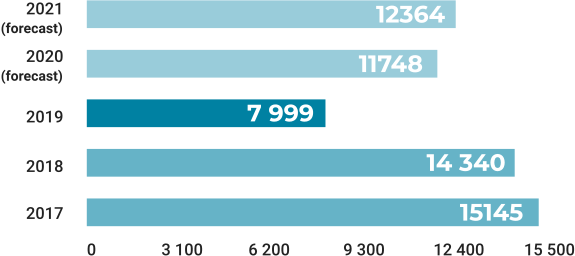
Following the 2019 results, sales costs decreased by 6,342 mln. tenge compared to 2018 and amounted to 7,999 mln. tenge.
This deviation was caused by a decrease in electricity exports from 3,758 mln. kWh (the RF) to 967 mln. kWh (Uzbekistan) in 2019.
Forecast for the future period:
In the forecast for 2020, an increase in sales costs compared to the 2019 actual is 47 % due to an increase in the cost of electricity transmission, which results in an increase in exports to Uzbekistan.
Administrative costs, mln.tenge
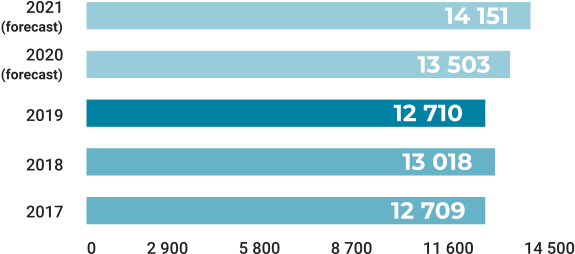
At the end of 2019, administrative expenses amounted to 12,710 mln. tenge, which is 308 mln. tenge or 2 % less in comparison with the same period in 2018.
Forecast for the future period: in the forecast for 2020, administrative expenses are higher than the 2019 level and amount to 13,503 mln. tenge. An increase is mainly due to rising prices for goods and services, as well as due to the annual indexation of inflation.
In the forecast for 2021, administrative expenses are reduced by 649 mln. tenge compared with the forecast for 2020 and amount to 14,151 mln. tenge mainly because of an increase in prices for goods and services.
Finance costs, mln. tenge
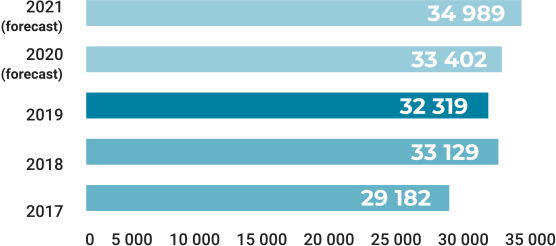
According to the 2019 results, financial expenses amounted to 32,319 mln. tenge, which is less than the 2018 actual figure by 810 mln. tenge.
The decrease in financing expenses is mainly due to reduction of interest expenses in connection with long-term loan repayments.
Forecast for the future period:
in 2020–2021 forecast, finance costs increases due to working capital financing.
Share in profits of joint ventures and associates and impairment of investments
| Indicator, mln. tenge | 2017 (actual) | 2018(actual) | 2019 (actual) | 2020 (forecast) | 2021 (forecast) |
| Share in profits of joint ventures and associates | (26 636) | 9 752 | 11 191 | 2 347 | 20 589 |
Share income for 2019 amounted to 11,191 mln. tenge, having increased by 1,440 mln. tenge compared to the same period.
The main changes occurred with respect to the following assets: «Ekibastuz SDPP-2 Plant» JSC – loss reduction by 2,346 mln. tenge in comparison with the previous year was caused because of the below factors: — an increase in operating profit by 486 mln. tenge (an increase in the weighted average tariff for electricity from 7,53 tenge / kWh to 8,70 tenge/kWh); — the decrease in foreign exchange losses in the amount of 5,703 mln. tenge.
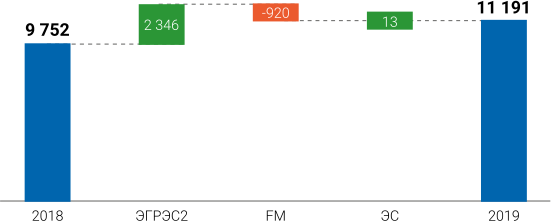
At the same time, finance costs increased in the amount of 484 mln. tenge (50 %) and reduction of other income by 3,379 mln. tenge (50 %). Forum Muider – the decrease in profit by 920 mln. tenge was mainly driven by reduction of coal sales volumes at “Bogatyr- Komir” LLP in the domestic market by 1,779 thous.tons (5 %) and the decrease in sales prices by 0.4 %. The share of profit in the plan for 2020 is 2,347 mln. tenge (the decrease is mainly due to foreign exchange losses), in 2021 it is 20,589 mln. tenge.
Profit/ (loss) from discontinued operations
| Indicator, mln.tenge | 2017 (actual) | 2018 (actual) | 2019 (actual) | 2020 (forecast) | 2021 (forecast) |
| Profit from discontinued operations | 1 670 | (1 584) | – | – | – |