“Environment” category
Historically the world produced electricity and heat by using fossil fuels. Chemical reactions that occur when firing coal, gas and fuel oil lead to the natural formation of a number of substances, which in the absence of appropriate control can lead to the loss of the required quality of the environment. For such control, there is a system of state regulation in Kazakhstan in the form of environmental and natural resource law.
Therefore, the RK Environmental Code classifies primary production activities of Samruk-Energy subsidiaries as special nature management, and these activities are regulated by the relevant requirements and standards. Thus, each subsidiary and affiliate of “Samruk-Energy” JSC is responsible for its environmental footprint within the obtained environmental permit and other conditions of special nature management.
The RK environmental legislation encourages nature users to reduce their impact on the environment using economic incentive mechanisms. Along with that, “Samruk- Energy” JSC, being an environmentally responsible company, is not limited only by domestic law, but also strives to come closer to more ambitious international standards. Guided by the principles of sustainable development and best international practices, the Company set itself the environmental policy, goals and objectives, which are taken into account in the Company’s Development Strategy.
ISO 14001 “Environmental management” has been introduced at all companies of “Samruk-Energy” JSC that are engaged in operating activities.
As part of EMS, all SA identify significant environmental aspects, assess and manage environmental risks and opportunities, distribute roles and responsibilities, set goals to reduce the negative impact on the environment, develop emergency response plans, etc.
As measures that prevent damage to environment, a continuous environmental assessment of the effectiveness of production processes is conducted through industrial environmental monitoring. The monitoring is based on measuring and calculating the rate of emissions into the environment, harmful production factors. Industrial environmental monitoring is carried out with the involvement of independent laboratories accredited in the manner established by the RK legislation in the field of technical regulation. Atmospheric air, surface and underground waters, soils are the subjects of industrial monitoring.
In addition, preventive measures include mandatory environmental insurance and liquidation funds.
Particular attention is paid to the new technologies: RES development, oil fuel-free start-up and other energy-efficient technologies that are offered by specialists in the framework of regular environmental and energy audits. Given that national experts predict that coal will continue to play the role of the most reliable strategic type of fuel for the development of power industry in Kazakhstan in the foreseeable future, we support the development of coal chemistry and comprehensive deep processing of coal. To this end, the Company established “Clean Coal Technologies” research laboratory together with Nazarbayev University AEO.
The implementation of a comprehensive environmental protection program in 2019 resulted in the following achievements:
— lack of emergency spills and other types of emissions;
— the share of renewable energy and hydropower generation – 9.5 % of the total output of “Samruk-Energy” JSC group of companies – In 2019, two hydroelectric units of “Shardarinsk HPP” JSC were commissioned as part of a project on the plant retrofit, a 416 kW solar power plant of “Samruk Green Energy” LLP was commissioned in Kapshagai city- this will lead to an increase in the share of “clean” generation.
— reduction of unit emissions of СО2 emissions across Samruk-Energy group of companies by 1 % in comparison with 2018 is due to the decrease of fuel power plants’ share of generation and an increase in HPP generation share.
— reduction of unit dust emissions (fly ash) by 2 %, unit emissions of NOx by 3 %;
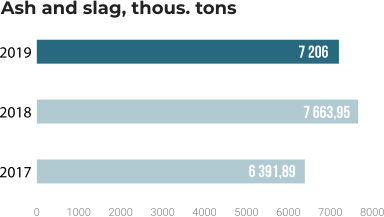
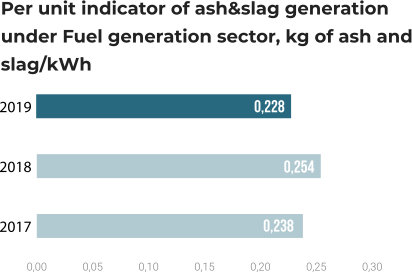
— a 6 % decrease in the unit indicator of ash and slag waste generation compared to 2018 due to the decrease of coal output and an improvement of the UCSF.
Environmental Compliance
In order to prevent environmental damage, the legislation provides for environmental audits, fines for violating legal requirements may be imposed according to the results of these audits.
In 2019, the authorized body conducted an unscheduled inspection of compliance with environmental laws at CHP- 3 of “APP” JSC. At the end of the audit, a fine was issued for exceeding the emission standards of pollutants (g/s) for СО, NOx and SO2.
In addition, in relation to “Ekibastuz SDPP- 2 Plant” JSC, the authorized body conducted a preventive monitoring of compliance with environmental requirements with a visit to the monitored entity. According to the results of the analytical control of pollutant emission sources, a maximum of 70–20 % of inorganic dust emissions (coal dust) was recorded at CHP, and facts of operation of vehicle, the pollutant content of which exceeds the established standards, were revealed.
The monetary value of significant fines and the total number of non-financial sanctions for non-compliance with environmental laws and regulations

All fines were paid in a timely manner. Corrective measures were taken. In accordance with Article 81 of the Environmental Code of the Republic of Kazakhstan, the reasons for an obligatory environmental audit of individuals and legal entities are:
1) significant damage to the environment caused by business or any other activity of individuals and legal entities, documented;
2) reorganization of the legal entity-subsoil user, carrying out environmentally hazardous types of business or other activities, in the form of merger, separation;
3) bankruptcy of legal entities-subsoil users engaged in environmentally hazardous types of business and other activities.
An obligatory environmental audit was not conducted at Samruk-Energy Group’s entities in 2019 because abovementioned legal grounds were not available.
In 2019, individuals and legal entities filed 7 complaints related to environmental protection, 6 of which were received by “APP” JSC. All cases were reviewed and worked out in accordance with the internal grievance mechanism.
Total environmental expenditures and investments, broken down by types
In accordance with the current legislation of the Republic of Kazakhstan, each subsidiary of “Samruk-Energy” JSC of I-III category has an environmental protection plan approved by authorized body, the implementation of which is an obligatory condition for special nature management.

Aspect “Water and waste water”
Today the world is experiencing a crisis related to the lack of clean water; experts predict the worsening of the problem without due attitude. So, the United Nations declared 2018– 2028 decade as an international decade dedicated to the role of water in sustainable development.
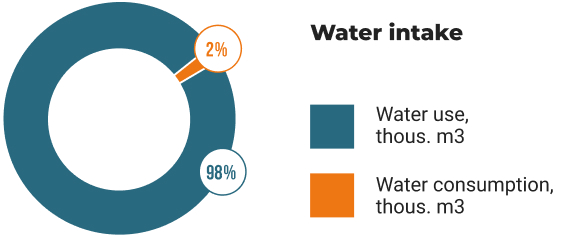
In the production activities of “Samruk-Energy” JSC group of companies, this renewable natural resource is used as a force that allows spinning the generator rotor to generate electricity at hydropower and thermal power plants, and also as a coolant when transferring heat to CHP and boiler houses. In addition, water is used to feed reservoirs, to irrigate ash beaches, to maintain the water level in ash dumps, and for public living needs. Considering that “Samruk-Energy” JSC’s portfolio also includes hydropower and thermal power plants, we subdivide our interaction with water into water use and water consumption, respectively. At this, 98.5 % of the volume of water withdrawn is classified as water use at hydropower plants, and 2 % – as water consumption.
Thus, the main sources of water for technological needs are: the Sharyn River and Bestyubinsk Reservoir (Moynak Hydropower Plant), the Syrdarya river and Shardara reservoir (Shardarinsk hydropower plant), channel named after K. Satpayev (“Ekibastuz SDPP named after Bulat Nurzhanov” LLP, “Ekibastuz SDPP-2 Plant” JSC), Shidertinsky channel (“Ekibastuz SDPP-2 Plant” JSC), Big Almaty Lake and the basin of Big Almaty Lake (Cascade of HPP), Kapshagai Reservoir (Kapshagai HPP).
Reverse water supply systems with a bulk reservoir-cooler and once-through hydraulic ash removal systems are used for saving natural resources at Ekibastuz stations; In addition to recirculating water supply systems, Almaty power plants reuse wastewater from ash dumps owing to the unique ash and slag waste disposal technology.
Wastewater of production enterprises of “Samruk-Energy” JSC group of companies consists of industrial and domestic wastewater. The main volume of wastewater is industrial wastes; they are not discharged into natural objects. They are used as hydrotransport to remove ash and slag waste to ash dumps.
The quality and volume of wastewater is regulated by law, and before discharge, the wastewater undergoes appropriate treatment to approved sanitary standards. At the same time, analytical monitoring of surface water environments, monitoring of wastewater, monitoring of processes of changing water and temperature regimes of groundwater through a network of observation wells, repair of equipment and pipelines of HAH system are carried out on a regular basis.
“Samruk-Energy” JSC main objective regarding water resources protection is to minimize the impact, including:
— decrease in fresh water consumption;
— reduction of wastewater discharges and concentrations of harmful substances in wastewater;
— increase in the share of reused water (water circulation).


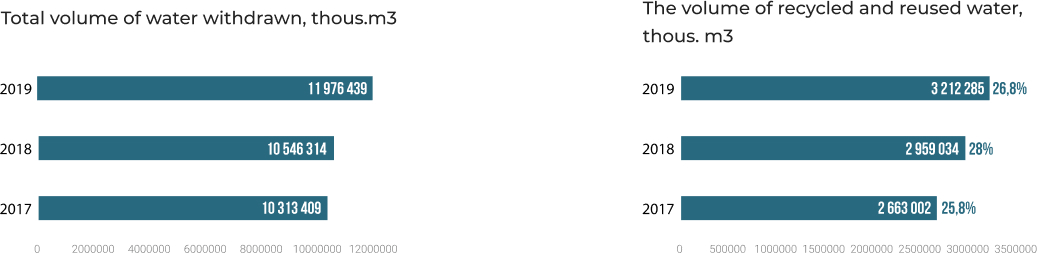
The share and total volume of recycled and reused water for the reporting period
Aspect “Biodiversity”
International experts are concerned about the extent of uncontrolled consumption and some activities that lead to habitat destruction and the extinction of species. The Convention on Biological Diversity turned 27 in 2019.
During this time, the world community has become aware of the dependence on all types of natural resources and the extent to which their shortage affects investment, reputation and, as a result, the economic performance of a business. “Samruk-Energy” JSC evaluates the “Biodiversity” aspect as significant in relation to HPP, WPP and REC. The rest of the enterprises do not directly affect the wild vegetation and wildlife because they are located within settlements or in industrial territories.
Thus, “Samruk-Energy” JSC subsidiaries operations may have a negative impact on the ornithological fauna, fish fauna and other freshwater ecosystems, as well as on the flora and fauna of coastal zones. An environmental impact assessment including on the flora and fauna is performed in order to minimize this impact at planning production activities.
| Operational site | Geogrpahic location | Location with respect to a protected area or area of high biodiversity value outside protected areas | Type of operations | The value of biodiversity, characterized by a feature of a protected area or area with high biodiversity value outside the protected area | Territory management status / class |
| “FWPP” LLP | Ereymentau city, Akmolinsk region | Buyratau State National Natural Park is 45 km away | Electricity production | There are 2 species of birds included in the Red Book of Kazakhstan in Ereymentau mountains (imperial eagle and steppe eagle). However, clusters of birds were found in lowlands and forest plantations along highways and railways, which in turn are located away from the wind turbines installed at the WPP. Cases of collision with the wind turbine blades since the facility was commissioned were not reported. | Natural park |
| Moynak HPP | Almaty region | The Charyn National Park is located downstream of the Charyn River at about 55 km away from the Moynak Hydro power plant. | Electricity production | “Moynak HPP” JSC cooperates with UNDP experts in Kazakhstan on the project for preservation of relic aspen grove, which is located downstream of the Charyn River. | Natural park |
The EIA procedure is regulated by the legislation of the Republic of Kazakhstan. Monitoring of the impact on the flora and fauna in the course of further operation of enterprises is also regulated. At the stage of design, FWPP made provisions to reduce the environmental impact of wind power plants – given that light pollution leads to disruption of the biorhythms of living creatures, nighttime wind turbine lighting is minimized up to the use of only sidelights.
At “AZhC” JSC, in order to minimize the cases of death of birds on overhead lines from electric shock, lines are reconstructed by equipping with insulated wires (SIW). To reduce the impact on water and terrestrial (coastal) ecosystems, the operating modes of hydropower plants are agreed with the Committee for Water Resources of the Ministry of Ecology, Geology and Natural Resources of the Republic of Kazakhstan, mayor administrations, as well as with the management of SPNR (for example, in the case of Moynak HPP).
Coordination of water releases with authorized bodies is also carried out in the interests of agricultural land users, because the purpose of hydroelectric power plants is not only energy, but also irrigation, flood control and water supply. This measure aims to prevent and adapt to the effects of climate change. All hydropower plants are equipped with fish protection devices.
In addition, on the recommendation of Kazakh Research Institute of Fisheries, as a fish protection measure, the surface of the water at night is illuminated by spotlights near the water intake in front of the turbine water conduits, thus light spots scares the fish.
The movement of fish occurs through bends for idle spillway (IS). Visual field observations were introduced at HPP and WPP to monitor the impact on the plant and animal world.
Aspect “Emissions”
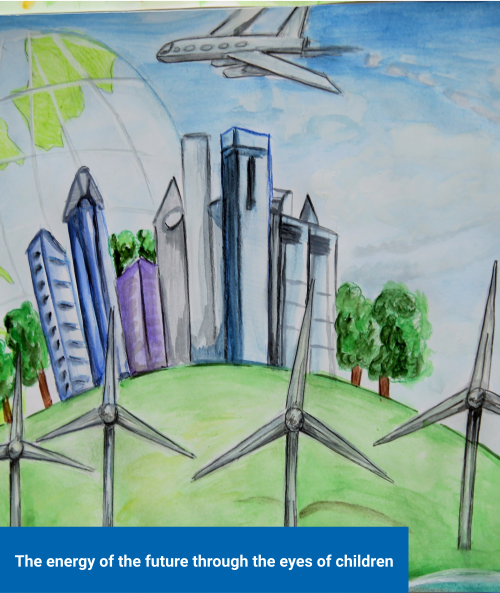
In 2019, two hydroelectric units of “Shardarinsk HPP” JSC were commissioned as part of a project on the plant retrofit, a 416 kW solar power plant of “Samruk Green Energy” LLP was commissioned in Kapshagai city – this will lead to an increase in the share of “clean” generation.
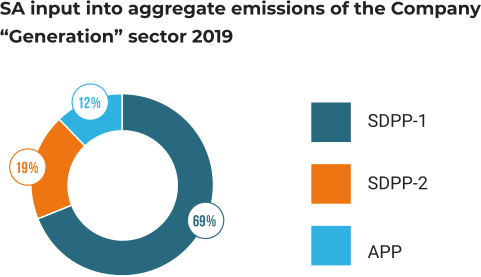
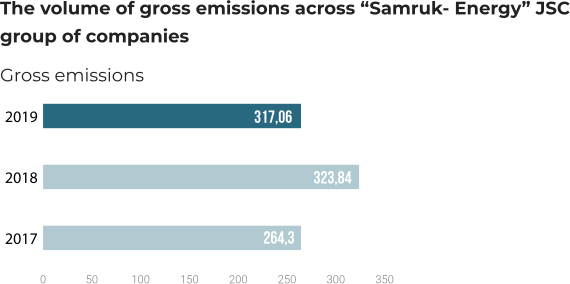
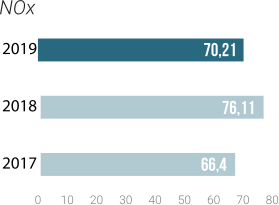
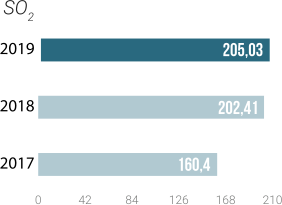
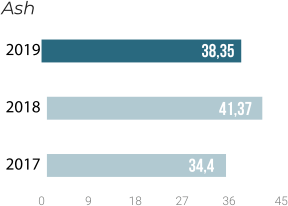
According to the 2019 results, the following was achieved: reduction of specific CO2 emission across Samruk-Energy group of companies in comparison with 2018 (from 0,867 to 0,86 tCO2/mWh) owing to the decrease in the share of fuel stations’ output and an increase in the share of HPP output; specific pollutant emissions across the group of companies amounted to 10,5 g / kWh, which is 3 % higher than in 2018 due to an increase in specific emissions of sulfur dioxide, which in turn is caused by an increase in sulfur content in coal (2017 – 0.48 % , 2018 – 0.57 %, 2019 – 0.67 %); reduction of unit emissions of dust (ash) by 2 %, unit emissions of NOx by 3 %.
Direct greenhouse gas emissions

ODS and other emissions

Aspect “Waste”
The lack of balance in production and consumption results in the increase in the volume and types of waste at an unprecedented rate. When improperly managed, waste can become a serious source of pollution of air, soil and land, as well as groundwater with all its consequences.
The best way to reverse the observed trend is the so-called hierarchical procedure for waste management. Samruk- Energy also observes the hierarchy of waste management striving primarily to reduce waste generation per unit of output. The production process is bound to waste generation, and when managing those wastes enterprises strive to comply with environmental, sanitary and epidemiological requirements and standards in the field of treatment of certain types of waste.
Therefore, production waste at “Samruk- Energy” JSC group includes ash and slag waste at TPP and overburden at “Bogatyr Komir” LLP coal mine. These types of waste are classified as non-hazardous and make up a large proportion of the total waste.
For consumer waste (waste paper, plastic waste, mercurycontaining lamps, non-ferrous and ferrous scrap, electronic and electrical equipment, etc.) measures are provided for the separate collection and further transfer of this waste for processing or disposal to third-party companies. “Samruk-Energy” JSC SA do not import, export, transport, process any kind of hazardous waste.